Our vision
Our Vision on Water
Good water management starts with knowing how a system actually performs: not on the drawing board, but in the rain. At Staal Instruments we believe that measuring existing sewer, stormwater and surface-water systems under real conditions is the most direct way to keep them working as the climate changes.
The challenge
Designed with precision, rarely verified
Sewer and stormwater networks are carefully engineered. Design storms, runoff, pipe diameters, overflow thresholds and safety margins are all calculated in detail. Once a system is in the ground, however, those assumptions are rarely checked again. Maintenance usually follows fixed cycles of several years, and problems often come to light only through an overflow or a complaint.
Meanwhile, two things are changing. Extreme rainfall is becoming more intense than many existing networks were designed for. At the same time, capacity can be lost without anyone noticing, through sediment, roots, deformation or undocumented connections. Together, they eat into the margin a system was built with.
Inspection and monitoring
Condition is not the same as performance
Inspection shows the condition of a pipe at one moment: cracks, deformation, the state of the pipe wall. It does not show whether the system still does what it was designed to do when it is under load. A pipe can look sound and still have lost a third of its capacity. And because cleaning usually comes before the camera, the sediment that says most about the remaining capacity is often gone before anyone looks.
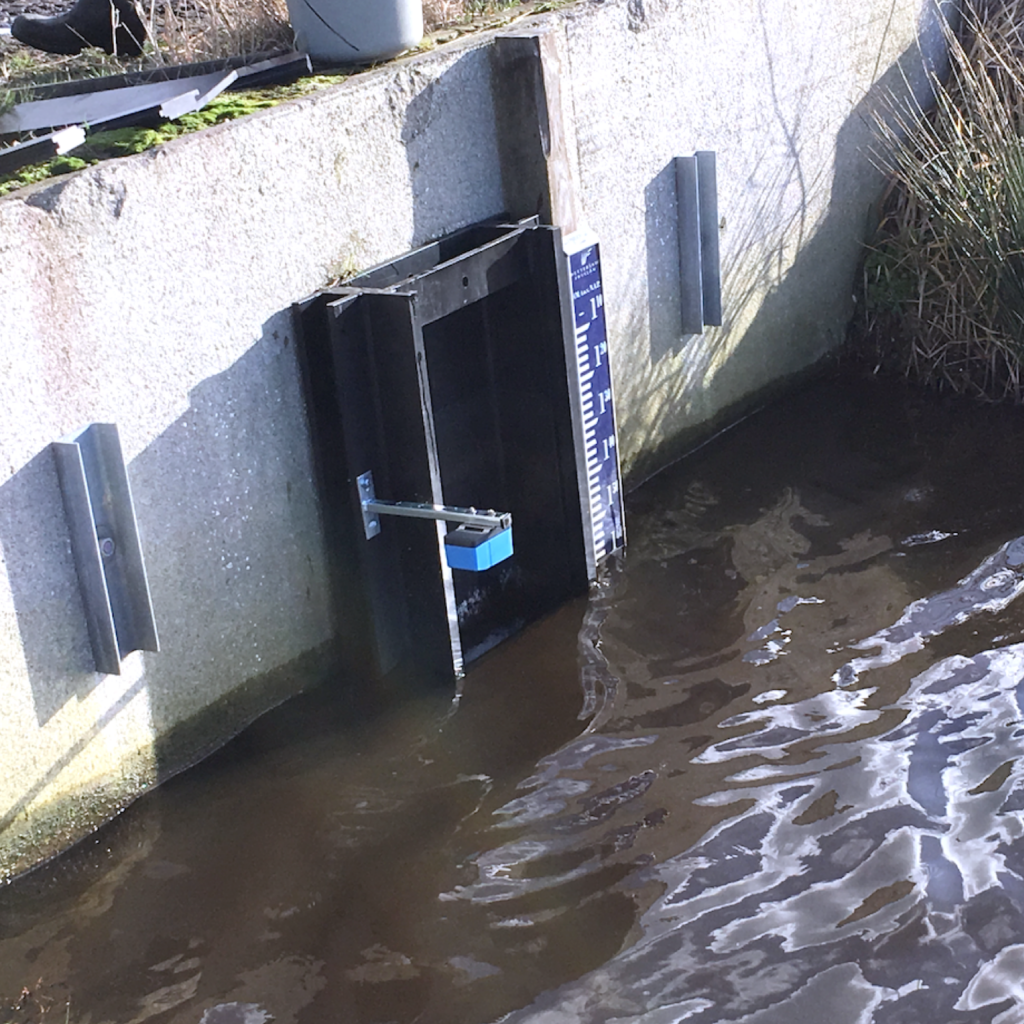
Regular measurement adds what inspection cannot: how water levels respond in practice, rain event after rain event.
Our approach
Make the most of the capacity already in the ground
Replacing ageing networks wholesale is not affordable on the timescale the climate sets. The realistic route is to use the capacity that already exists first, and to expand only where it demonstrably falls short. That requires knowing where the margin has shrunk. Our aim is to help water managers to:
Understand capacity
See how assets behave during and after rainfall.
Target maintenance
Move from cleaning on a fixed schedule towards maintenance based on measured behaviour. That matters all the more now that sewer staff are scarce, in the Netherlands for example.
Underpin investment
Base expansion, renewal and adaptation decisions on measured performance rather than on age alone.
In practice
What measurement already shows
Baarle-Nassau
In Baarle-Nassau, on the Dutch–Belgian border, one rain shower in December 2024 produced two different responses at comparable measuring points. One side returned to its normal level within about three days; the other took about six. Both levels stayed well below every alarm threshold. Yet that difference in recovery time is exactly the kind of behaviour a water manager wants to know about.
Weert
The municipality of Weert had a problem in its sewer network without knowing where to find the cause. With our measurements, the issue was identified after the first period of heavy rainfall.
Regulation
Why now
The recast Urban Wastewater Treatment Directive (EU) 2024/3019 must be transposed into national law by 31 July 2027. It requires authorities first to monitor and report storm overflows and untreated discharges, and then to reduce them. That starts with knowing where and why a network loses capacity. Today, utilities that monitor their overflow discharge points serve only 3% of the EU27 population (EurEau, 2026).
Our ambition
Our ambition
We want to help water managers see how their systems actually perform, so they can act before problems build up. Our ambition is fewer floods and fewer untreated discharges, maintenance where it matters most, renewal decided on measured performance rather than age, and climate-adaptation investments whose effect can be demonstrated.
Staal Instruments has developed level instrumentation for sewer and stormwater since 2015. Today, more than 2,000 of our wireless, battery-powered radar level sensors are in service in 22 countries, measuring in sewers, surface water, groundwater and tanks, with their data collected in the StaalCloud platform.
Want to know how water levels in your system behave under real conditions?